Have you ever sent a long, heartfelt message only to receive a single-letter response: “K”? It feels like a digital slap in the face, doesn’t it? In the fast-evolving world of 2026 digital communication, the term K Mean has become one of the most debated topics. Whether you are a Gen Z navigating a heated argument or a data scientist working on K-means clustering, understanding what K Mean represents is essential.
This comprehensive guide will break down the literal, emotional, and technical facets of K Mean, helping you decode every “K” you receive.
What Does K Mean in Text?
In its simplest form, K Mean in a text message is shorthand for “OK” or “Okay.” However, in 2026, a single letter is rarely just a letter. It carries a heavy emotional weight that can change based on who is sending it and when. It sits alongside other clipped affirmatives like MK, which carries a similarly casual, low-effort tone.
Basic Meaning of K in Text
At a surface level, the K Mean is an acknowledgment. It tells the sender, “I have seen your message and I acknowledge it.”
- Literal Meaning: Shorthand for “Okay.”
- Why People Use K: It’s fast, efficient, and requires minimal effort—perfect for when you’re driving, in a meeting, or just feeling lazy.
Emotional Meanings of K in Text
The psychological impact of K Mean is fascinating. Depending on the “vibe,” it can be interpreted in four distinct ways:
| Tone | Context | Emotional Impact |
| Neutral | Confirming a logistics plan (e.g., “On my way”). | Informative, no hidden drama. |
| Passive-Aggressive | Sent during or after a disagreement. | Feels like a “shutup” or “I’m done.” |
| Cold/Dismissive | No emojis or punctuation. | Indicates low interest or lack of time. |
| Angry | Sudden shift from long texts to “K.” | A clear red flag of irritation. |
Psychological Insight: Why does K Mean feel so harsh? According to linguistics experts, the shorter the response, the less “emotional labor” the sender is putting in. A single “K” lacks the warmth of “Okay” or the friendliness of “Kk.” This is the same principle behind why a blunt SMH can land as more dismissive than a fuller sentence would.
K vs OK vs Okay (The Big Difference!)
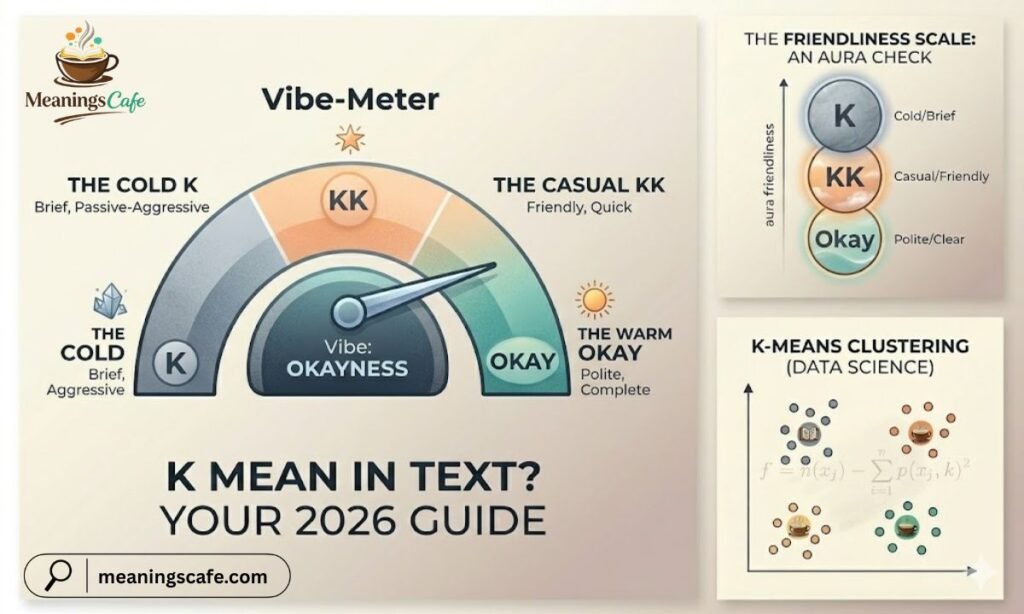
Not all “okays” are created equal. Here is how they rank in the 2026 “Friendliness Scale”:
- Okay: The gold standard. Respectful and clear.
- OK: Professional and standard.
- Kk: Friendly, bubbly, and safe.
- K: The “danger zone.” Use with caution.
Technical Side: K Mean in Python and Data Science

While most people search for K Mean regarding texting, it is also a cornerstone of machine learning. Specifically, K-means clustering is an algorithm used to group unlabeled data.
K Means Clustering Formula
The algorithm works by minimizing the distance between data points and their respective “centroids.” The mathematical objective is to minimize the Sum of Squared Errors (SSE):
$$J = \sum_{j=1}^{K} \sum_{i=1}^{n} \| x_i^{(j)} – c_j \|^2$$
Where:
- $K$ = Number of clusters.
- $n$ = Number of cases.
- $x_i$ = Case $i$.
- $c_j$ = Centroid for cluster $j$.
K Means Clustering Example
Imagine you have a list of 1,000 customers. You want to group them by “Spending Habit” and “Age.” The K Mean algorithm will automatically find the center (mean) of these groups and categorize each customer into the most relevant cluster.
When Is K Totally Normal?
Despite its bad reputation, K Mean isn’t always a sign of a breakup. It is perfectly acceptable in:
- Professional Tasks: “Got the file?” — “K.”
- Fast-Paced Group Chats: Where messages move too quickly for long replies.
- Busy Situations: When the sender is genuinely occupied.
Cultural Differences in Using K
The way we interpret K Mean varies significantly by demographic:
- Younger Users (Gen Z/Gen Alpha): View “K” as peak passive-aggression.
- Older Users (Boomers/Gen X): Often use “K” simply for efficiency, unaware of the “rude” connotation. It’s much like how YH gets used casually by older texters without registering the same edge younger users read into it.
- Regional Differences: In some cultures, brevity is seen as a sign of respect and directness rather than coldness.
K on Social Media: From Discord to Instagram
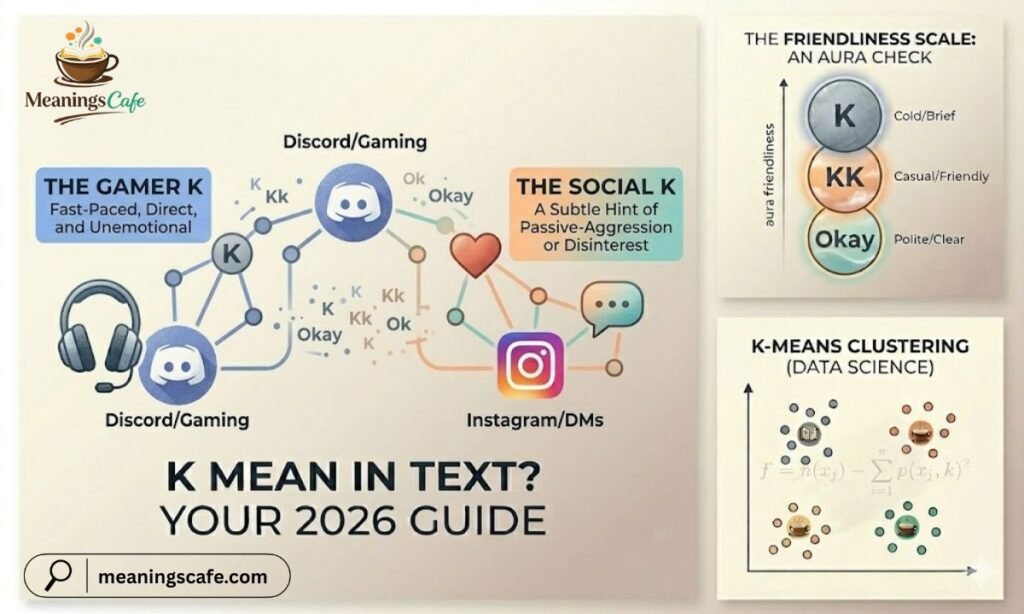
- Gaming & Discord: In high-stakes gaming, “K” is the standard for “Understood/Acknowledged” because every millisecond counts.
- Direct Messages (DMs): A “K” in a DM often signals the end of a conversation, not unlike how TTYL is used to wrap things up.
- Comments: Using “K” in a comment section is often dismissive or used to “shut down” a troll.
How to Respond When Someone Sends K?
If you’re on the receiving end of a K Mean and you aren’t sure how to feel, try these four options:
- Match the Energy: Send a “K” back (only if you’re okay with things staying cold).
- Clarify: “Hey, are we good? That ‘K’ felt a bit short.”
- Change the Topic: Ignore the brevity and move on to something lighter.
- Give Space: If they are actually angry, a short response means they need a breather.
Frequently Asked Questions
Is “K” always rude?
No, it depends on the person’s usual texting style and the current context.
What is the difference between K and KK?
“K” can feel dismissive, while “KK” is generally seen as friendly and casual.
Why do guys send K in text?
Usually, it’s for efficiency or because they are busy, though it can sometimes mean they are annoyed.
Does K mean “thousand” in text?
Yes, in financial or gaming contexts (e.g., $10k), but in a chat reply, it means “okay.”
When did the use of “K” first become popular?
It gained popularity during the 90s pager and early SMS era when character limits forced users to shorten words.
Conclusion
Understanding the K Mean is all about reading between the lines. While the literal K Mean is just an abbreviation for okay, its social and emotional “aura” is much more complex. Whether you are using it to save time or as a subtle hint of your frustration, remember that in 2026, digital etiquette is just as important as verbal communication.
Navigating these digital nuances ensures your message isn’t just received, but also correctly interpreted. By mastering the K Mean and its varied implications, you can bridge the gap between efficiency and empathy in every chat.
If you are a beginner looking to improve your “texting game,” try swapping that “K” for a “Sounds good!” or a simple emoji. Your friends (and your relationship) will thank you!

Devon Conway is the founder of MeaningsCafe.com, with over four years of professional experience in language research and semantic analysis. He specializes in providing precise, insightful content that uncovers the meanings, origins, and significance of words for a global audience.