In the rapidly evolving landscape of digital communication, keeping up with slang can feel like a full-time job. If you’ve recently seen the word “ION” pop up in your messages or social media feeds, you might be wondering if it’s a scientific term or a typo. In short, when you see ION in a casual text, it is almost always a phonetic contraction of the phrase “I don’t.”
As we move through 2026, the way we communicate is shifting toward agentic search patterns and Generative Engine Optimization (GEO). Understanding these micro-linguistic shifts is essential for staying culturally relevant in an AI-integrated society.
This guide will break down everything you need to know about this popular slang term.
The Core Meaning of ION in Text
The most common way to see ION mean something in a digital conversation is as a shorthand for “I don’t.” It is a phonetic spelling that mimics the way the phrase is often pronounced in casual, fast-paced speech, particularly within African American Vernacular English (AAVE).
- Example: “ION care” → “I don’t care.”
- Example: “ION know” → “I don’t know.”
While it looks like an acronym, it doesn’t stand for three separate words. Instead, it captures the sound of the words “I” and “don’t” being slurred together during a conversation.
Other Popular Meanings of ION in Texting
While “I don’t” is the heavy hitter, the digital world is vast. Depending on the context—especially in professional or technical niches—you might find ION means something entirely different.
| Context | Meaning | Usage Example |
| Slang/Texting | I don’t | “ION think so.” |
| Science | Charged Atom | “The lithium ion battery is dead.” |
| Business/Tech | In Other News | “ION, the meeting is moved to 4 PM.” |
| Gaming | Ion Cannon/Weapon | “Wait for the ION to recharge.” |
Why Do People Use ION in Texts?
Speed is the currency of 2026. With the rise of AI-native communication, users are increasingly prioritizing brevity. People use this slang because it is faster to type than “I don’t,” which requires an apostrophe and more finger movement.
Furthermore, using ION means you are tapped into current linguistic trends. It signals a level of casual comfort and cultural awareness that “I do not” simply cannot convey. It’s about efficiency, rhythm, and belonging to a specific digital subculture.
Examples of ION in Everyday Texts
To truly understand how to use it, you need to see it in action. Here are common scenarios where you’ll see ION mean “I don’t”:
- Declining an invitation: “ION feel like going out tonight, I’m exhausted.”
- Expressing ignorance: “ION even know who that person is.”
- Setting boundaries: “ION appreciate the way you’re talking to me.”
- Apathy: “ION care what we eat for dinner, you pick.”
ION vs Other Similar Texting Slang
Texting slang often overlaps. It’s helpful to see how ION compares to other popular contractions used in 2026.
- IDK: Short for “I don’t know.” While ION can be used in “ION know,” IDK is more specific to that one phrase.
- IDC: Short for “I don’t care.” Similar to above, ION is more versatile as a general replacement for “I don’t.”
- IKR: “I know, right?” This is the opposite of ION, as it confirms agreement rather than negation.
Understanding why ION mean something different than “IDK” comes down to how much of the sentence you want to abbreviate.
How to Use ION Naturally in Your Texts?
Using slang can feel awkward if it’s forced. To use ION meaningfully in your own chats, follow the “vibe check” rule. Only use it in casual settings with friends, peers, or on social media.
Pro-Tip: Avoid using ION in professional emails or when communicating with your boss, unless your workplace culture is extremely informal.
To sound natural, treat it as a direct replacement for “I don’t.” If you wouldn’t say “I don’t” in that specific sentence, don’t use ION.
ION in Social Media Platforms
Different platforms have different “dialects.” Here is how ION is trending across the major players in 2026.
TikTok
On TikTok, ION meaning is often tied to “storytime” videos or “GRWM” (Get Ready With Me) clips. Creators use it in captions to save space while maintaining a relatable, “bestie” tone. It’s also frequently used in the comment sections to express quick opinions.
Snapchat
Snapchat is the home of rapid-fire communication. Because snaps are ephemeral, users care less about grammar and more about speed. Seeing ION mean “I don’t” is standard practice in Snap captions.
On Instagram, you’ll find ION in Reels and Threads. As Instagram moves toward more text-based engagement via Threads, ION meaning has shifted into more conversational, long-form debates where users want to appear authentic and unpolished.
In international groups, be careful. While ION mean “I don’t” in the US and UK, global users might get confused. However, in casual Gen Z and Gen Alpha group chats, it’s the standard.
Twitter / X
With character limits still a factor, ION is a lifesaver. It’s used to truncate thoughts and maximize the impact of a hot take.
Regional Interpretations of ION
While ION has gone global thanks to the internet, its roots remain in AAVE. In regions like the Southern United States, the pronunciation of “I don’t” naturally drops the “d” and “t” sounds, making ION a literal transcription of the local accent.
In 2026, we see ION meaning varying slightly in intensity; in some regions, it’s used strictly for “I don’t,” while in others, it’s used more broadly to mean “I’m not” (though this is less common).
ION Meaning Medical Terminology
It is vital not to confuse slang with science. In a healthcare or laboratory setting, ION means an atom or molecule with a net electric charge due to the loss or gain of one or more electrons.
You might hear about “Ion channels” in the heart or “Ionization” in radiology. If your doctor says ION meaning something about your bloodwork, they are definitely not using texting slang!
Cultural Relevance of ION
The adoption of ION into mainstream texting is a prime example of how digital “Search Intent Clustering” works. People search for the term because it represents a bridge between cultural identity and digital efficiency.
It shows the enduring influence of AAVE on global pop culture. In 2026, linguistic diversity is celebrated, and using terms like ION is a way for users to express their personality within the AI-discovery ecosystem.
ION Meaning in Human Body
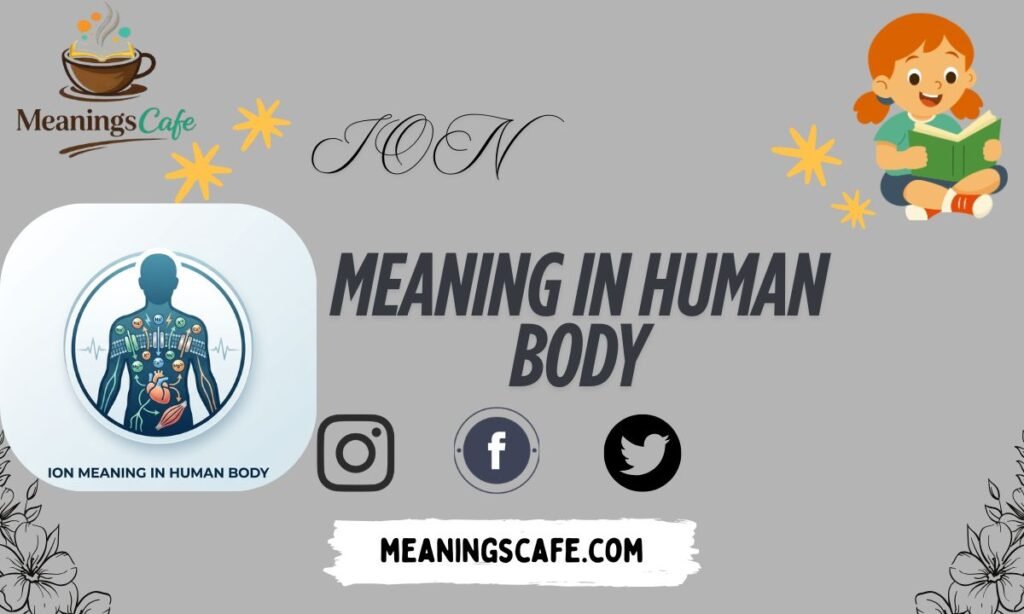
Following the scientific path, an ION means everything to your survival. Your body relies on ions (electrolytes) like sodium, potassium, and calcium to send electrical signals.
- Nerve Impulses: Ions moving across cell membranes allow you to think and move.
- Muscle Contraction: Calcium ions are the “on switch” for your muscles.
Without these ions, your body couldn’t function. So, context is king! If you’re in a biology class, ION mean life; if you’re on TikTok, it means “I don’t.”
Common Mistakes When Using ION
- Over-capitalization: Writing “I.O.N.” makes it look like an acronym (In Other News). Just use “ion” or “ION.”
- Wrong Context: Using it in a formal essay.
- Confusion with “I’m”: Some beginners think ION mean “I am,” leading to confusing sentences like “ION going” (which would mean “I don’t going” instead of “I’m not going”).
Examples of ION in Different Scenarios
- Gaming: “ION have any ammo left!”
- Dating: “ION think we’re a good match, sorry.”
- Shopping: “That’s cute, but ION have the money for it right now.”
In every case, if you replace it with “I don’t,” the sentence remains perfectly intact.
Quick Grammar Tip
Technically, “ION” is a non-standard contraction. In formal linguistics, it is a pronunciation-based spelling. Because it already contains the “I,” you do not need to add another “I” before it.
- Correct: “ION know.”
- Incorrect: “I ION know.” (This would translate to “I I don’t know.”)
Frequently Asked Questions
Is ION an acronym?
No, in most texting contexts, it is a phonetic spelling of “I don’t” rather than an acronym like LOL.
Is it rude to use ION in a text?
It isn’t inherently rude, but it is very casual. Use it with friends, but avoid it in professional or formal settings.
Does ION mean “I’m on”?
Usually, no. While “I’m on” sounds similar, ION is almost exclusively used for “I don’t” in modern slang.
Can I use ION in a professional email?
It is not recommended. Professionalism in 2026 still favors standard English to ensure clarity across diverse AI and human readers.
Why is ION trending in 2026?
It’s part of the “Authentic Human” movement, where people use specific slang to differentiate their writing from generic AI-generated text.
Conclusion
Understanding what ION mean is a great first step in mastering 2026 digital etiquette.Understanding what ION mean is a great first step in mastering 2026 digital etiquette. Whether you are navigating the nuances of social media or just trying to understand what your kids are saying, remember that context is everything.
Most of the time, it’s just a quicker way to say “I don’t.” By staying updated on these trends, you ensure your digital presence remains sharp, relatable, and fully optimized for the modern age. Keep practicing, and soon you’ll be using ION as naturally as a native digital citizen!

Devon Conway is the founder of MeaningsCafe.com, with over four years of professional experience in language research and semantic analysis. He specializes in providing precise, insightful content that uncovers the meanings, origins, and significance of words for a global audience.