In the rapidly shifting landscape of 2026 digital communication, understanding what IDEK means is essential for anyone navigating social media. Whether you are a Gen Z native or a beginner trying to keep up, the way this acronym captures a specific type of confusion is fascinating.
This guide provides a deep dive into the term to ensure you never feel lost in a group chat again.
What Does IDEK Mean in Text?
If you are asking what IDEK means in a message, the answer lies in its four letters: I Don’t Even Know. While it shares a root with “IDK” (I Don’t Know), the reason people choose this version is the inclusion of the word “Even.” This small addition transforms a neutral statement into one filled with emphasis, frustration, or total bewilderment.
What IDEK Really Means in Text?
Beyond the literal translation, the phrase signals a complete lack of logic. When a situation is so chaotic that you cannot find the words to explain it, that is where saying IDEK mean the most. It is a digital shrug of the shoulders, signaling to the recipient that the topic at hand is beyond your understanding or patience.
IDEK Meaning
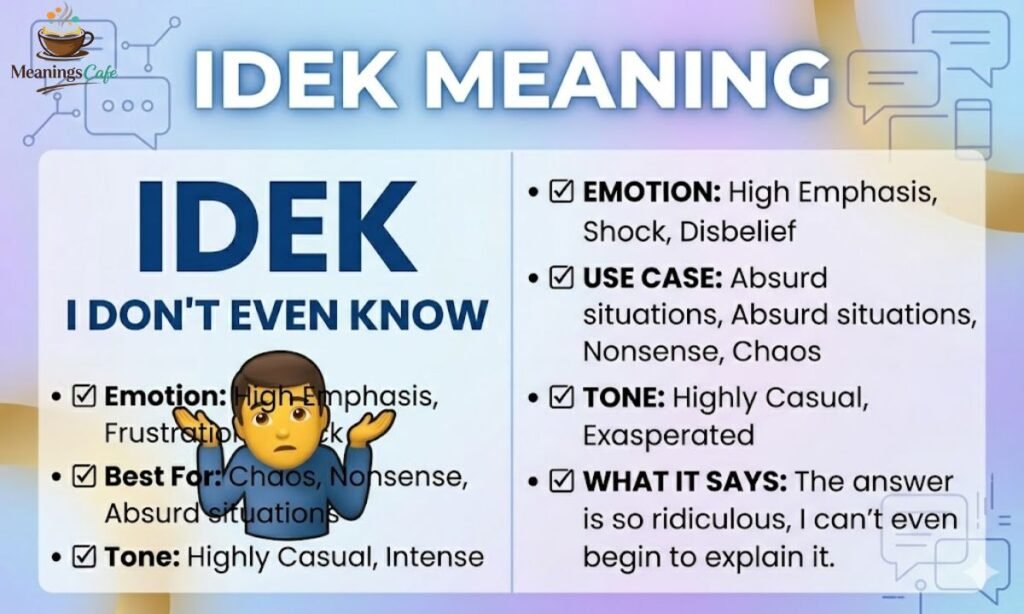
The core IDEK meaning is rooted in the “Peak of Confusion.” In 2026, where information overload is common, it acts as a mental circuit breaker. It tells the other person, “Stop asking me, because my brain has reached its limit.”
Why Do People Use IDEK in Modern Texting?
The reason why IDEK means so much in modern texting is due to the need for emotional efficiency. We don’t have time to type out long sentences about our feelings. Knowing how the term expresses “I’m overwhelmed” allows for faster communication. It bridges the gap between raw data and human emotion perfectly.
Comparison of Confusion Levels
| Term | Full Form | Emotion Level | Best Use Case |
| IDK | I Don’t Know | Low | Simple facts (time, place) |
| IDEK | I Don’t Even Know | Medium/High | Absurd or frustrating news |
| IDWTA | I Don’t Want To Ask | High | Something too weird to touch |
How to Pronounce IDEK?
While the phrase represents “I don’t even know,” the pronunciation is usually just the letters: Eye-Dee-Ee-Kay. In some niche online gaming circles, you might hear “Eye-deck,” but generally, the slang is strictly communicated through text rather than spoken word.
IDEK Meaning from A Girl
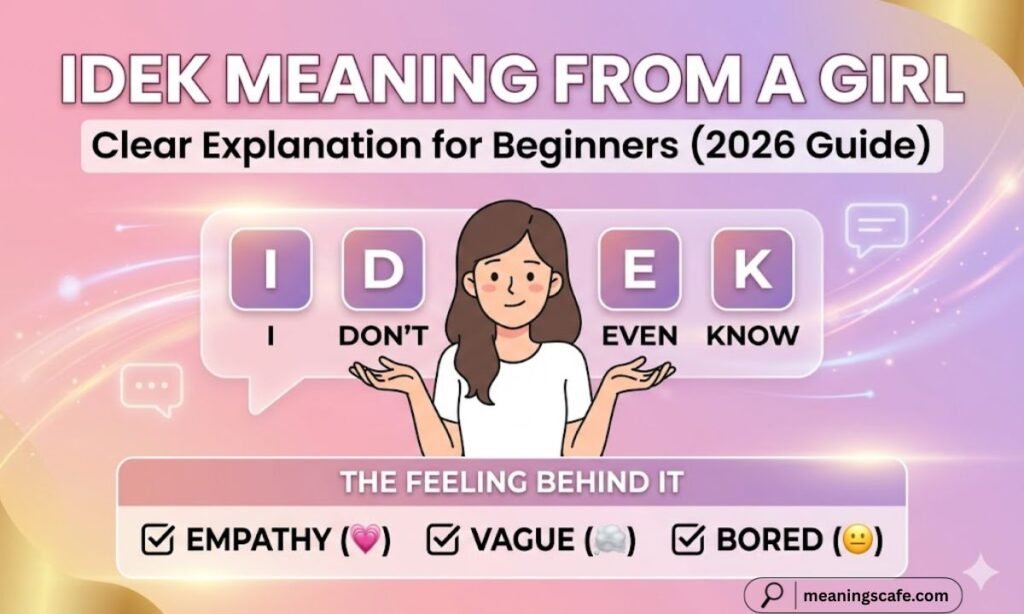
In dating or social dynamics, an IDEK meaning from a girl can be nuanced. If she is talking about a stressful day, it suggests she needs support. However, if the conversation is dry, it might mean she is losing interest or is bored with the topic. Context is everything when deciphering what it signals in these interactions.
Common Situations Where People Use IDEK
There are several high-frequency situations where this slang is most effective:
- Workplace Chaos: When your boss gives contradictory orders.
- Social Media Viral Trends: When a trend makes no sense to you, you might also throw in a confused wth for extra emphasis.
- Relationship Drama: When a friend tells a story about an ex that sounds toxic.
Emotional Meaning Behind IDEK
The psychology of what IDEK means is linked to “Cognitive Dissonance.” When reality doesn’t match our expectations, our brains struggle. Using this shortcut helps release that tension. It is a way of saying, “I acknowledge this exists, but I refuse to spend energy trying to solve it.” Some people pair it with a quick smh to show disbelief without typing out a whole reaction.
Real-Life Examples of IDEK in Conversations
- Scenario A: “The teacher gave us homework on a Sunday?” -> “Honestly, idek, she’s been moving weird lately.”
- Scenario B: “How did the cat get on top of the refrigerator?” -> “I don’t even know, cats are just aliens.”
- Scenario C: “Why is my crypto wallet down 90%?” -> “Man, idek mean, the market is a total mess.”
IDEK Night: Contextual Warning
In literary studies, “Idek” is a specific person in the book Night. However, in 2026, 99% of online searches for what IDEK means are related to slang. If you are a student, remember that the acronym has nothing to do with the character in the book.
Variations and Related Slang to IDEK
To fully understand the language, you should also be familiar with:
- IDEKL: I don’t even know, lowkey.
- IDEKRN: I don’t even know right now.
- IDKC: I don’t know/care.
The core concept of being “lost” is the foundation for all these variations, and it overlaps with shorthand like ion, which also compresses “I don’t” into a single beat.
IDEK vs. IDK — What’s the Difference?
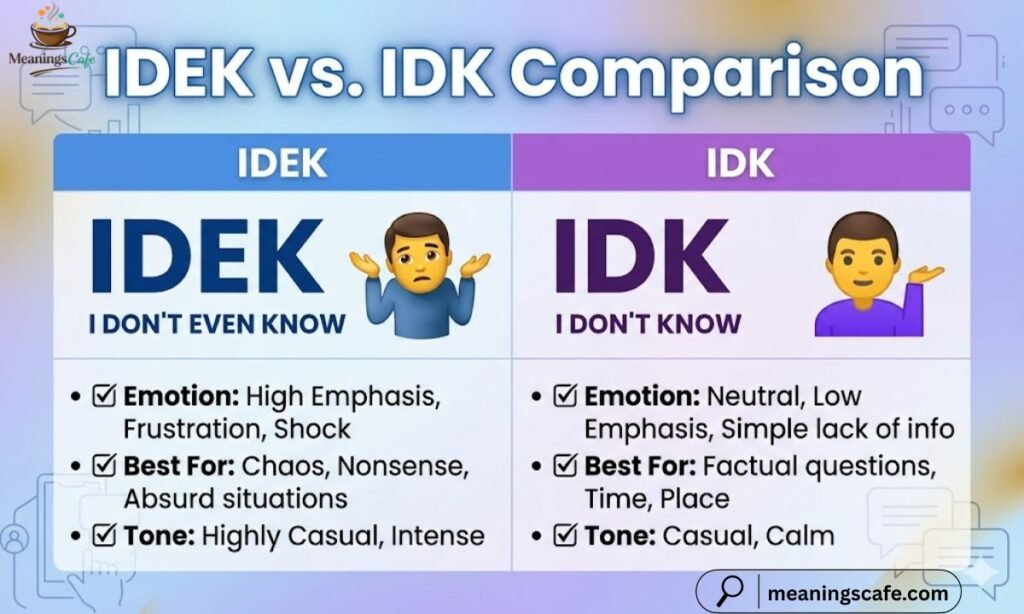
This is a critical distinction for SEO ranking and user intent:
- IDK: Is functional. (e.g., “IDK the answer to question 5.”)
- IDEK: Is expressive. (e.g., “IDEK mean how we are going to pass this exam.”)
The “Even” is the emotional anchor that makes the phrase so popular today.
Is IDEK Formal or Informal?
It is vital to know that the term is strictly informal. Using it in a professional setting could make you look immature. Always stick to full sentences in offices, and save the IDEK mean vibes for your best friends and casual DMs.
Grammar and Positioning Table
| Placement | Example | Tone |
| Start of Sentence | “IDEK why you’re mad.” | Defensive |
| Standalone | “Person A: Why? Person B: IDEK.” | Baffled |
| End of Sentence | “It’s all just a mess, idek mean.” | Defeated |
Cultural Meaning of IDEK in Internet Language
The 2026 digital culture thrives on “Chaos Humor.” In this environment, the trend has become a symbol of the “Modern Mood.” It signifies that we are living in a world where things happen so fast that “not knowing” is the only honest response, much like the exasperated energy behind tf in a reaction comment.
Why Has IDEK Become So Popular?
The explosive growth of what IDEK means is tied to TikTok and Snapchat. When creators post “storytimes” that are hard to believe, the comments section is filled with people using this acronym. It creates a sense of community through shared confusion.
Is IDEK Rude or Offensive?
Usually, no. But because it implies a lack of engagement, it can be hurtful if used in a serious relationship moment. If your partner asks “Do you still love me?” and you reply with “Idek,” that is a major red flag.
Is IDEK Used by All Age Groups?
Surprisingly, yes. While it started with Gen Z, many Boomers and Gen X parents are learning what IDEK means so they can communicate better with their children. It has become a cross-generational bridge in family group chats.
The Psychology of Acronyms in 2026
Our brains are wired for shortcuts. This specific acronym satisfies our need for speed while still allowing us to vent our feelings. It is a fascinating look at how language evolves to serve human psychology.
Is IDEK Going Out of Style?
Data shows that the search volume for the term is actually increasing in 2026. As long as the internet remains a place of mystery and weirdness, people will always need a way to say, “I don’t even know.”
Long Examples of Dialogue Using IDEK
Example 1: The Confused Student
- Student A: “Did you see the new grading rubric? It says we need 20 sources for a 2-page paper.”
- Student B: “Honestly, idek means what they want from us anymore. I might not even show up tomorrow.”
Example 2: The Tech Support Nightmare
- User: “My computer is making a clicking sound and the screen is purple.”
- Tech: “Look, idek how that’s physically possible without a virus. We need to reset the whole thing.”
Frequently Asked Questions
What does IDEK mean in text?
IDEK means “I Don’t Even Know,” used to emphasize extreme confusion.
Is it rude to use?
It’s fine in casual chats but can be dismissive in serious discussions.
Why is it better than IDK?
Because it expresses a stronger emotion and more disbelief.
Can I use it in an email?
No, it is strictly for informal texting and social media.
What is the emotional weight behind it?
It represents being overwhelmed, frustrated, or completely baffled.
Is it still popular in 2026?
Yes, it remains a top-ranking slang term for digital communication.
Conclusion
To wrap it up, knowing what IDEK mean is a vital part of being “internet literate” today. From its humble beginnings as a variation of IDK to its current status as a cultural staple, the acronym covers a wide range of human emotions. Whether you are frustrated with tech or laughing at a meme, you now have the perfect tool to express your confusion.
Remember, the next time the world makes no sense, just drop an “idek” and you’ll fit right in!

Devon Conway is the founder of MeaningsCafe.com, with over four years of professional experience in language research and semantic analysis. He specializes in providing precise, insightful content that uncovers the meanings, origins, and significance of words for a global audience.